


Many designers feel the job market tightening, but it’s not just a vibe. Is AI replacing design jobs? Data from research institutions, hiring platforms, and labor-market analysts shows that AI is reshaping the industry in ways we can’t ignore. Roles are shifting, demand is evolving, and the impact is hitting some designers much harder than others. If you want the short version: yes, AI is replacing design jobs. But the situation is more complex, and not all designers are affected equally.
Let’s start by looking at how companies are using AI today.
How companies use AI in 2026
Generative AI is now deeply embedded in digital workflows.It supports early design concepts, creates copy, suggests layouts, and produces interface drafts. It also handles screening, prototyping tasks, and support flows. McKinsey’s 2024 State of AI report, notes:
“Generative AI has the potential to automate up to 70 percent of business activities across almost all occupations, raising productivity at a pace we haven’t seen before.”
This shift doesn’t remove designers from the process, but it changes how teams work and how many people they need. A wireframe that once required a full day now takes a couple of hours. The same happens with text and content creation. Lorem Ipsum is basically gone. AI-generated content has taken its place. In almost every step of the design process, there is a portion of the work that can be automated or accelerated thanks to AI. Adding up all the time that using AI saves us, AI-powered design tools have reduced project times by up to 30%, as shown in this article from Zipdo. We also see that 67% of design firms now integrating AI tools into their workflows and the global AI in design market is expected to reach $2.7 billion by 2026.
How AI Is Replacing Design Jobs in 2026
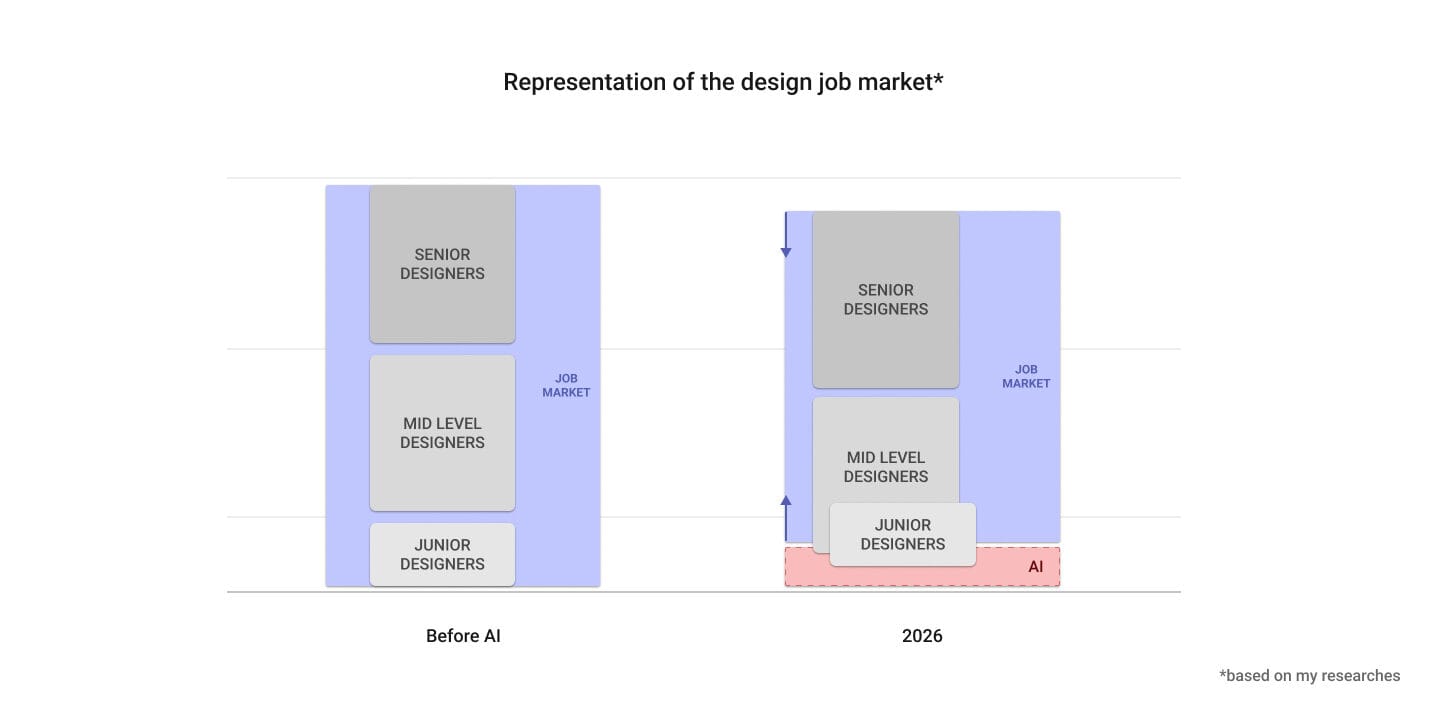
In just a few years, we’ve witnessed a radical shift in the job market. With the rise of AI, most companies have rushed toward automation and optimization to stay competitive. The core mechanism behind the shrinking job market is simple: when productivity rises dramatically, companies can achieve the same output with fewer hires. Generative AI now allows teams to complete projects up to 30% faster, which reduces the need to build large design teams for routine execution. The Nielsen Norman Group reported in 2024 that not only have design job postings decreased, but the qualification bar has also become significantly higher:
“UX job postings are significantly lower than in 2021, and roles that do open tend to require broader skills and more years of experience.”
AI hits junior designers first
Almost all sources agree: junior roles suffer the most from this shift. Entry-level designers historically handled production tasks: wireframes, visual variations, content prep; exactly the tasks that AI now accelerates or automates. A 2024 research paper from Stanford’s Digital Economy Lab notes:
“Early-career workers in AI-exposed occupations have experienced notable declines in employment and job postings relative to previous cohorts.”
This is one of the strongest signals we have. When AI automates early-stage execution, the job market loses the entry points that young designers rely on. If you would like to learn more about this topic, below is a link to a video by Economy Media that discusses how AI is eliminating entry-level white-collar jobs.
Hiring patterns are shifting toward senior talent
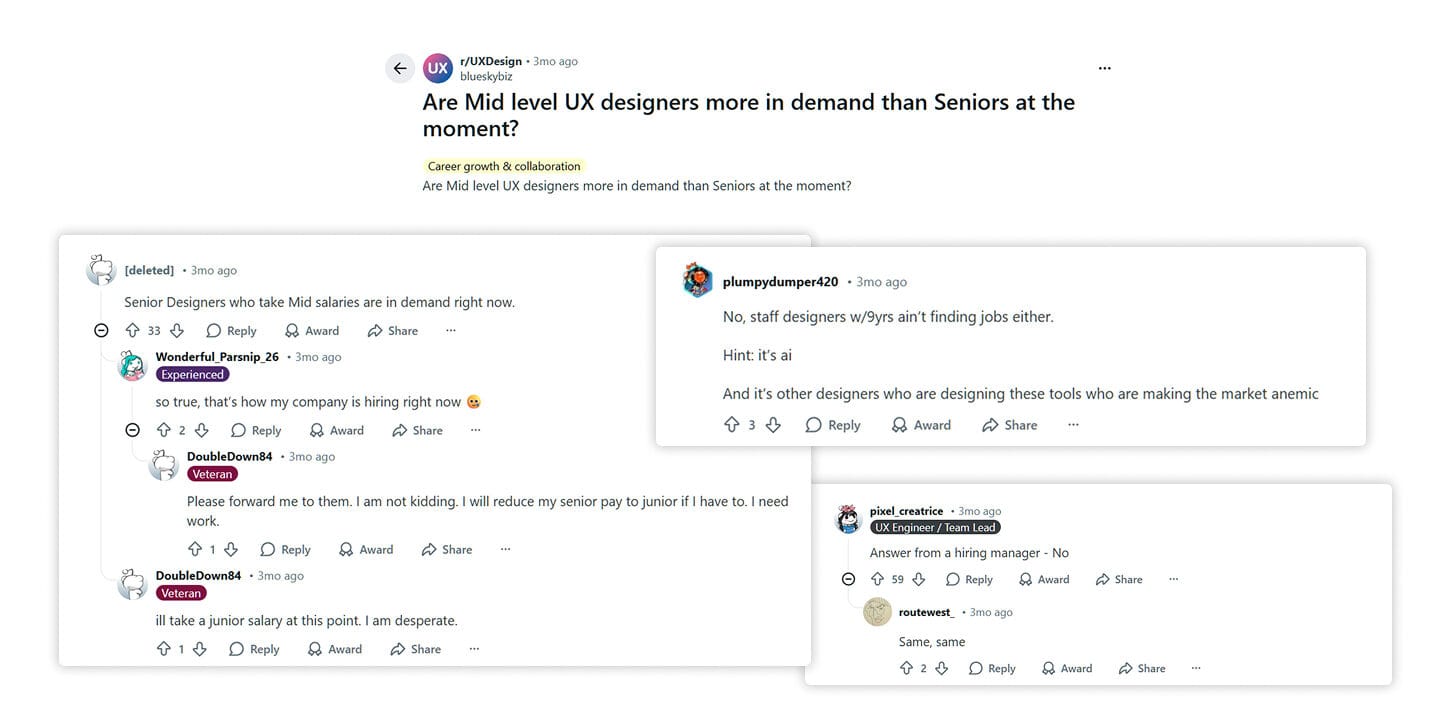
Workforce data from LinkedIn and industry agencies shows a clear trend. Junior openings keep shrinking. Hybrid skills grow in demand. UX paired with research, product, or AI becomes the new norm. Many senior designers now step into roles that used to target mid-level profiles, which increases competition for every open position. According to the LinkedIn Workforce Report 2024, companies are now:
“prioritizing candidates with proven experience as automation reshapes both workflows and team structures.”
In simple terms, companies hire fewer designers but expect more from each of them. AI also creates a larger stream of material that needs evaluation and testing, so experienced designers become even more valuable.
AI boosts output, but quality still requires humans
AI-generated wireframes, text, and layouts are fast but imperfect. They require human review, product sense, and alignment with business goals. Designers (as well as developers for code) increasingly act as supervisors and integrators of AI-generated material rather than manual producers. McKinsey notes that while automation expands:
“most occupations will be complemented rather than replaced by AI systems.”
This means designers stay relevant, but their roles shift, especially toward strategic and evaluative tasks.
AI Replacing Design Jobs: conclusion
Evidence from Stanford, McKinsey, Nielsen Norman Group, and LinkedIn all point to the same pattern. AI accelerates production and reduces the need for junior or execution-heavy roles. At the same time, it increases the value of experienced designers with strategic and cross-disciplinary skills.
To sum it up:
AI replaces tasks, not full roles, but many junior jobs depended on those tasks.
Newcomers face a tighter job market with fewer entry-level opportunities.
Experienced designers remain safer for now, since strategic thinking is hard to automate.
AI skills now create a real advantage in any hiring process.
So AI isn’t removing designers altogether. It is narrowing the hiring funnel and increasing competition. The real question becomes: will the market stay like this in the future?
A glimpse of the future
This blog will return to the future of design work in another article, but current signals from Silicon Valley aren’t very reassuring. We are in the middle of an intense global AI race, with governments and private companies investing huge resources into new models and automation tools. If this pace continues, designers and developers will likely see even more tasks automated, which will reduce the volume of work available or shift demand toward highly specialized roles.
N.B: For a preview of what may come next, I recommend reading AI 2027, a paper written by leading researchers in Silicon Valley. If you prefer a visual breakdown, this video by the YouTube channel AI in Context explains the same report in a clear and accessible way. This topic deserves its own comprehensive look, and we’ll explore it in an upcoming article.