
Key takeaways
- Don’t compete on price: Raising my rates meant fewer clients, but better ones.
- Write everything down: A detailed contract protects both you and the client.
- Track your time: My estimates on medium-sized projects now land within 3 to 4 hours.
- Use AI where it saves real time: It cut the time of my first design stage by about 40%.
- Freelancing builds independence: It made me more organised, more persistent and more autonomous, and I’m continuing.

Where I started
My background is in UI/UX design. I completed a master’s in UI/UX design at Sorbonne Paris Nord and, alongside it, a work-study placement in Paris at a startup called Rainbow, where I worked in both English and French.
I had never worked as a freelancer before, so almost everything (prospecting, pricing, contracts, admin) was new to me. That is exactly why the year taught me so much.
My year as a freelance UI/UX designer in numbers
Here is what the year looked like on paper:
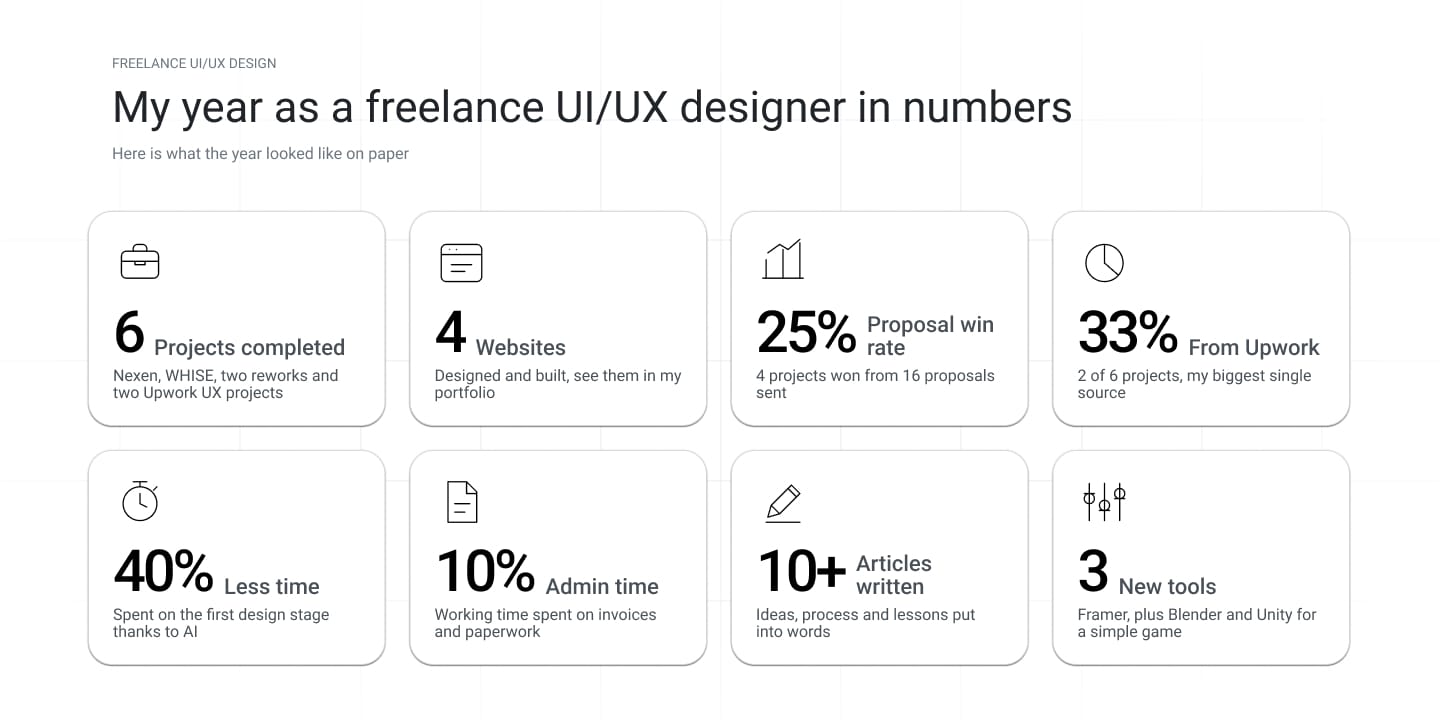
- 6 projects completed: Nexen, WHISE, two rework projects and two UX projects found on Upwork
- 4 websites designed and built (check out my portfolio)
- 16 proposals sent, 4 won: a 25% win rate
- About 33% of my projects came from Upwork (2 out of 6), my biggest single source
- 40% less time spent on the first design stage thanks to AI
- Around 10% of my working time spent on admin, invoicing and paperwork
- 10+ articles written
- 3 new tools: Framer for building websites, plus Blender and Unity for a side project I’m working on, a simple game
Throughout the year I kept working on what I love most: design systems, new websites, new designs, UX research and UI design.
The lessons from my first year as a freelance UI/UX designer
Finding clients
As a freelance UI/UX designer, the first thing I understood is that a big part of freelancing isn’t design at all: it’s prospecting. You have to go and look for your clients.
I worked with three platforms: Upwork, Fiverr and RemoteJobs. Platforms are a good starting point when you have no local network, but they only work if you’re deliberate about what you apply for. Of the 16 proposals I sent, 4 turned into projects. Today I choose where to apply based on the type of project, the budget and the client, instead of sending proposals everywhere.
Platforms were not my only source. Of my 6 projects, one came from my portfolio and one from LinkedIn, and the rest came from freelancing platforms and my local network. It’s a good reminder to keep your portfolio and your LinkedIn profile in shape even when platforms are your main channel.
Pricing and scoping
I started by underpricing, thinking it would bring me more clients. It didn’t. It undervalued my work, and the clients I did land paid less and expected more.
So I raised my rates. The result was fewer clients, but better ones: clients who respected the work and the process. If you’re starting out, my advice is not to compete on price. Pricing too low doesn’t make you more competitive, it just attracts the wrong kind of project. The one exception I would make is a reduced rate for one of your very first portfolio pieces, as long as the scope is clearly limited.
Scoping matters as much as the rate. I price by project, split the work into phases, and define upfront what is included, how many revisions there are and what happens if the scope grows. A fair price only holds if the scope is clear.
Contracts, brief and expectations
I put everything in writing: contract, quote and brief. My contracts are detailed on purpose. They include:
- What I will do and what I won’t do. Stating what is out of scope avoids most disputes.
- What the work consists of, with all the details.
- The timeline: when each deliverable and each revision is due.
- The number of revisions included in the price.
- The payment method and schedule. I usually ask for 50% at the start of the work and 50% at the end.
- Extra costs if the work takes longer than the time I initially estimated.
- The usual clauses of a professional contract.
I also structure every project in Notion before I start. That way I always have a clear view of how the project is going, and so does the client. Most misunderstandings in freelance work come from expectations that were never written down.
Communication with non-designers
Most of my clients aren’t designers, so I always try to understand who I’m talking to. I avoid technical terms if the person in front of me doesn’t know them. For example, instead of “information architecture” I say “how your pages are organised”. I explain, in a simple and effective way, what I’m doing, what needs to be done and why. Clients who understand the “why” make better decisions and trust the process more.
Project management
Project management is the part of freelancing where I improved the most, and the one I care about most.
I use Notion to manage every project. I divide each project into phases, based on the quote I gave the client. Even when the work is priced per project, I still track the hours I spend on it, to see whether I’m going over my initial estimate. In the Notion database I record how many hours go into each project and what I spend the most time on, and I use Notion Calendar to plan the work. This lets me check whether a project is following the timeline I set.
The result: my quotes got better during the year, and so did my time estimates. On medium-sized projects, my margin of error is now just 3 to 4 hours.
The same logic carries over to team environments. Phases, estimates and time tracking map directly onto sprints and backlogs in tools like Jira, which I have used in previous roles.
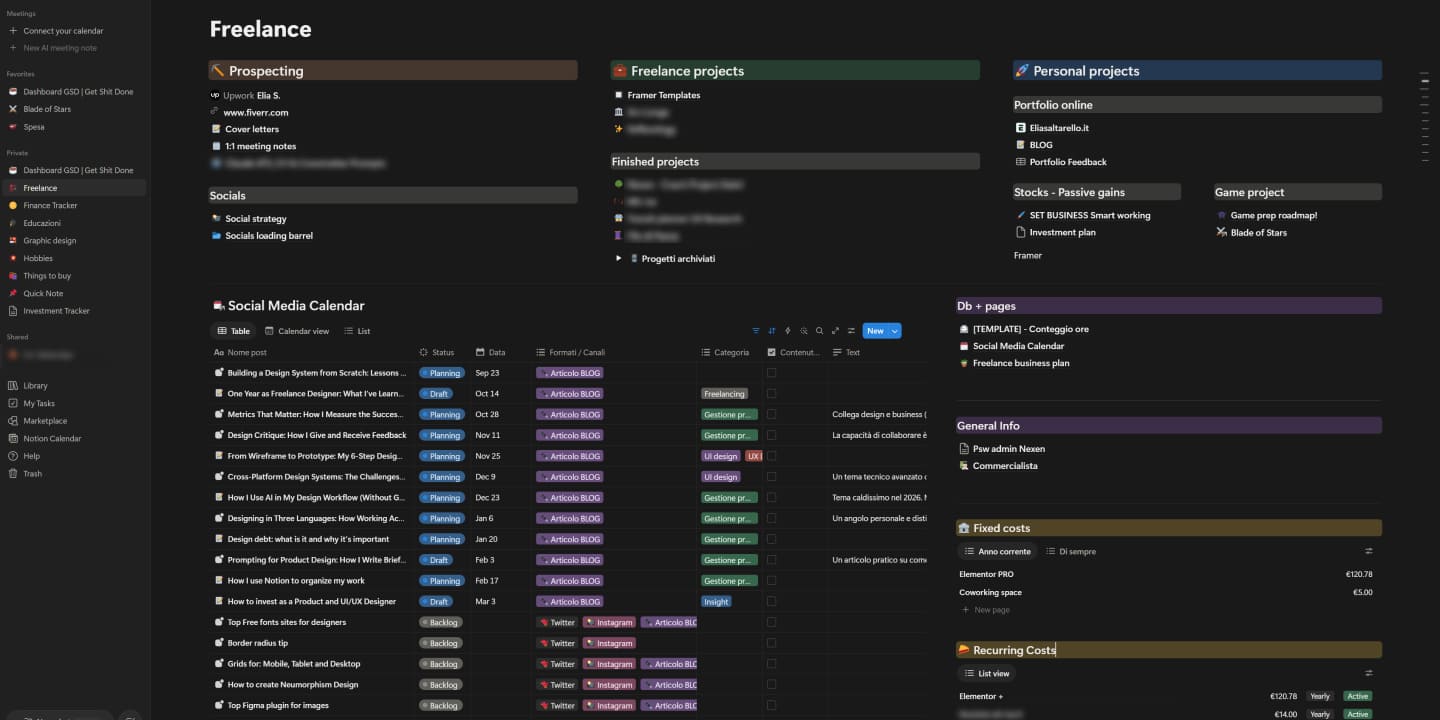
Business side: invoicing, admin and time spent on non-design work
At first, the admin side worried me. Invoicing, paperwork and everything that isn’t design takes time, and as a freelancer nobody does it for you.
Then I signed up for FiscoZen, which handles my invoicing and has saved me a lot of time. It only works for Italian freelancers. Disclosure: the FiscoZen link below is an affiliate link. If you sign up through it, I may earn a commission, at no extra cost to you. Sign up to FiscoZen with my link.
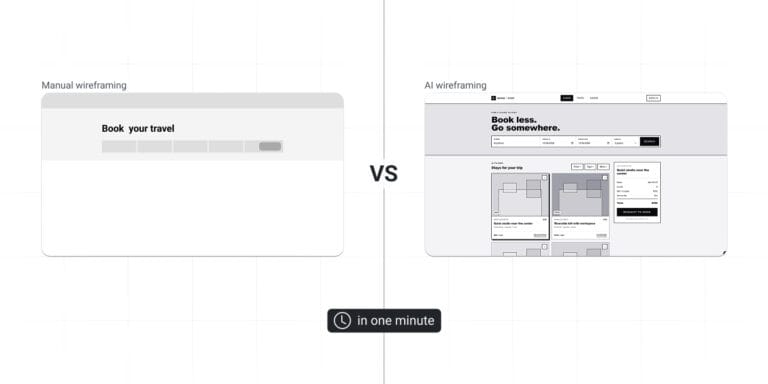
I also worked to reduce the time I spend on non-design tasks. I automated repetitive processes that were eating my time, and I used AI to speed up my delivery. The clearest example is the first design stage: using AI to generate first drafts and explore directions, I cut the time spent on that stage by about 40%. I explain my workflow in AI as a First Draft, Not a Final Answer. By the end of the year, admin took around 10% of my working time. The goal is simple: the less time I spend on admin, the more time I have for design.
Learning to say no
I received many requests, especially on Upwork, for badly paid jobs. At the beginning I accepted them. Then I decided to say no, because those jobs didn’t work in my favour: low pay, high expectations and no room to grow. Saying no left space for better projects.
It isn’t only about money. A vague scope, a client who doesn’t want to put anything in writing or a project that teaches me nothing are all good reasons to decline. It’s a skill I’d recommend practising from day one.
What freelancing taught me
- Persistence. Finding clients takes many proposals and many “no” answers.
- Organisation. With no manager, a clear system is the only thing that keeps projects on track.
- Open-mindedness. Every client, sector and brief taught me to look at problems from a different angle.
- Independence and ownership. I now take a project from first conversation to final delivery, and I take responsibility for every decision along the way.
- Automation. I learned to spot processes that were eating my time and to automate them.
- Using AI to cut delivery times. It speeds up my first design stage, while the judgement stays mine.
Mistakes I made and what I do differently
- I started without a local network. The market for UI/UX design in Venice is small, and I arrived with no connections in the area. Finding clients was harder than it needed to be. What I would do differently: before leaving Paris, I would build a network and line up a few clients, so I could start with work already secured. A local network is a real asset, even when you plan to work remotely.
- My prospecting was untargeted. I applied to too many things without a clear filter, and I lost a lot of time. Today I choose where I apply based on the type of project, the budget and the client.
- I underpriced and accepted badly paid jobs. It attracted the wrong clients and left me with little room to grow. Now I set my rates with care and I say no when a project doesn’t fit.
- My early estimates were too optimistic. Tracking my hours in Notion fixed that, and my quotes got far more accurate over the year.
Tools and habits that helped
The tools
- Notion: my main tool. I used it for almost everything: budgets (with a finance tracker), tasks, projects, time spent on each project, my library of books and education resources, and even the list of lessons I created during my master’s, which turned out to be very useful. By connecting it to my portfolio site, I also receive contact form submissions and visit information directly in Notion.
- Figma: the main tool I worked in every day, including for AI-generated first drafts.
- FiscoZen: invoicing and admin for Italian freelancers (see the affiliate disclosure above).
- Framer: an excellent tool for building websites. I discovered it and learned it from scratch this year.
- Slack: the tool I used most often to stay in touch with clients.
The habits
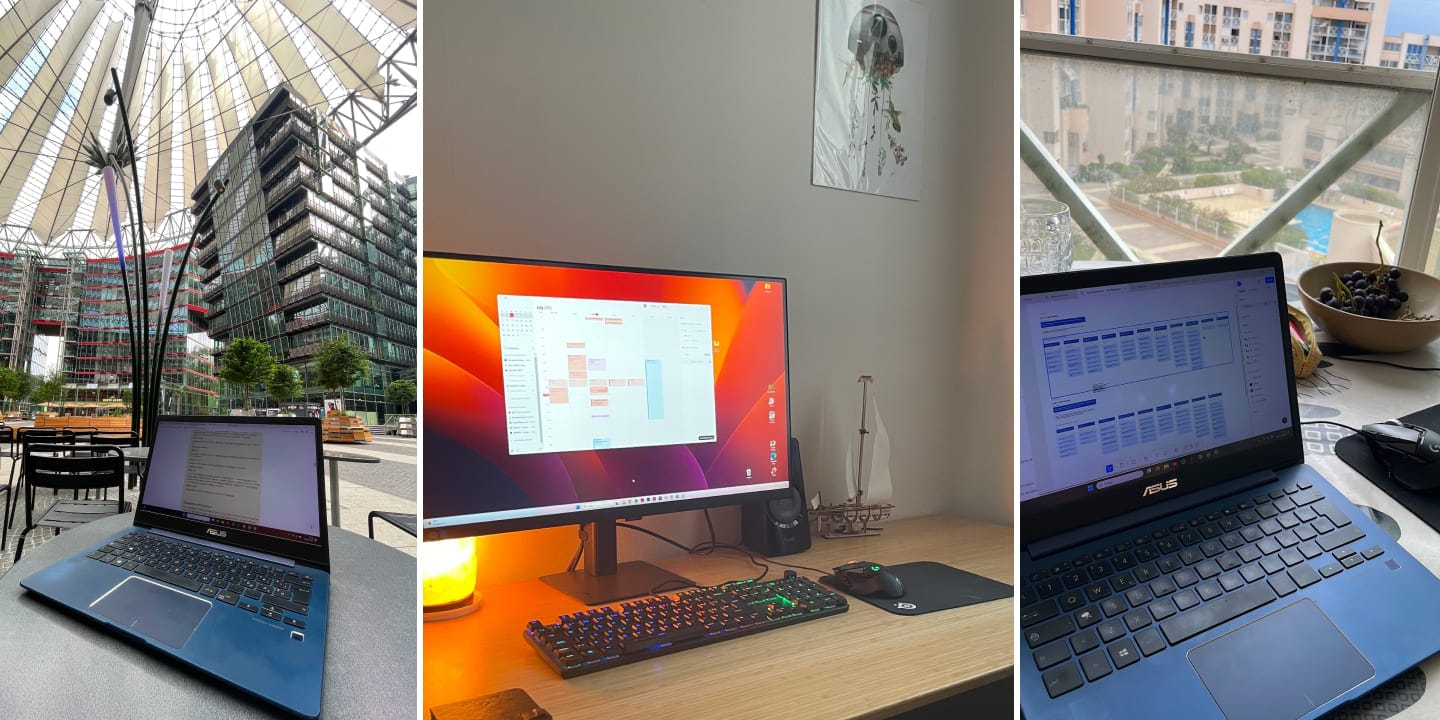
- Changing environment. Working from a café or a coworking space from time to time refreshed my motivation.
- Daily sport. Being able to exercise every day helped me stay focused through the whole working day.
- A stand-up with myself. Every morning I ran a short stand-up (not literally, of course) to set up the day: what I did yesterday, what I will do today and what could get in my way.
- A monthly review. At the end of each month I wrote a recap of what went well and what could be better, then set goals and indicators for the next month.
What’s next?
I’m going to continue freelancing. I’ve moved to Tours, in France, and freelance projects will stay a core part of my work: I enjoy the independence, the variety of clients and the speed at which I learn. I’m also open to joining a product team as a product designer or UI/UX designer, ideally in the Paris startup environment, where I would bring what this year gave me: ownership of a project from start to finish, clear communication with stakeholders, solid scoping and estimation, and an efficient AI-assisted workflow.
If you’re thinking about starting out as a freelance designer, I hope these lessons help you avoid a few of my mistakes. And if you need a UI/UX designer for a project, or you’re hiring a product or UI/UX designer in Paris, I’d love to talk: get in touch via my portfolio or connect with me on LinkedIn.